Seattle is a tech town that still runs on aerospace
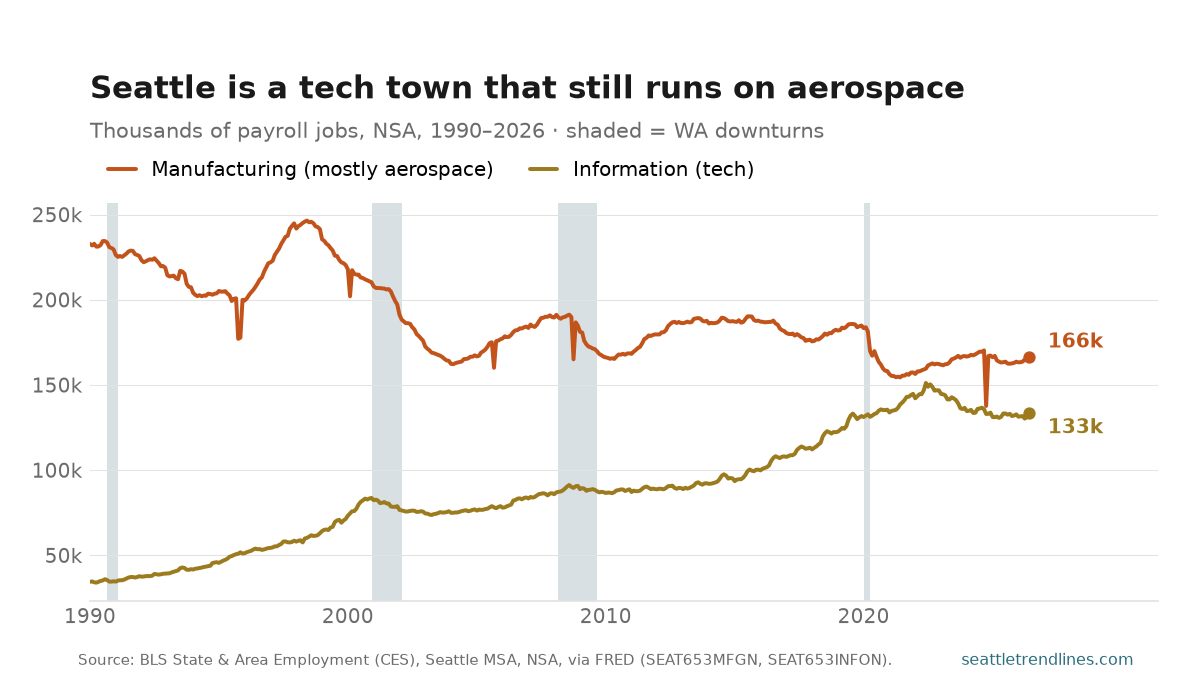
Seattle sells itself as a tech town — Amazon, Microsoft, a cloud on every résumé. But payrolls tell a stubborner story. In May 2026 the Information sector — software, publishing, telecom, the closest thing the official data has to “tech” — employed 131,200 people across the metro. Manufacturing, which here is overwhelmingly Boeing and its aerospace supply chain, employed 165,800. Aerospace still out-hires tech by about 35,000 jobs, and despite thirty-six years of Seattle becoming synonymous with software, these two lines have never crossed.
They have, however, spent a generation closing. In 1990 it wasn’t close: manufacturing employed 232,800 and Information just 34,500 — a gap of nearly 200,000. Information then climbed almost without interruption for three decades, the Microsoft-then-Amazon ascent, peaking near 151,200 in June 2022. Since then it has fallen for three straight years to 131,200, off about 13% from that peak — the local fingerprint of the 2023–2025 tech retrenchment. Manufacturing ran the opposite way: down about a third from its 246,500 high in 1998, with the violent single-month notches — 1995, 2005, 2008, and again in October 2024 — marking Boeing machinist strikes, visible because the series isn’t seasonally adjusted. The 2024 strike alone dropped the line to 137,700 before it snapped back.
The right edge is the surprise. Over the past year the town’s identity and its payroll data point in opposite directions: tech was flat (Information −0.1% year over year) while aerospace grew (manufacturing +1.6%), lifting the sector off its strike-year floor. So the convergence that looked inevitable for thirty years has stalled — not because tech overtook aerospace, but because aerospace stopped falling and tech stopped rising. Whether the crossover ever happens now depends less on Amazon than on Boeing’s order book.
One caveat on the labels. There is no clean monthly “aerospace” series for the metro, so this uses total manufacturing as the stand-in; in the Seattle MSA that is a fair proxy — aerospace dominates the sector — but it also sweeps in a tail of food, shipbuilding, and other production. “Information” likewise undercounts tech, since plenty of software work is booked under professional services. The levels are proxies; the shapes — one sector cresting and rolling over, the other grinding down and flattening — are the real story. For the fuller sector picture, see the jobs-by-sector breakdown.
Source: U.S. Bureau of Labor Statistics, State & Area Employment (CES), Seattle–Tacoma–Bellevue WA MSA, not seasonally adjusted, via FRED — Manufacturing and Information. Thousands of jobs, dated to the first of the month. New months post about three weeks after month-end; this chart refreshes on the next daily build.