Boeing delivered 64 jets in June — 54 of them built in Puget Sound
Boeing is still the Puget Sound’s largest manufacturing employer, and its monthly delivery count is the cleanest read on how busy the region’s assembly lines are. In June 2026 the company delivered 64 commercial airplanes: 50 737 MAX jets, 10 787-9 Dreamliners, three 767s, and one 777 Freighter.
Of those 64, 54 were assembled in Washington — the 737 in Renton, the 767 and 777 in Everett. The ten 787s are built in North Charleston, South Carolina, the one widebody line Boeing moved out of the region. So June’s tally is really 54 Puget Sound airplanes plus ten from the Carolinas.
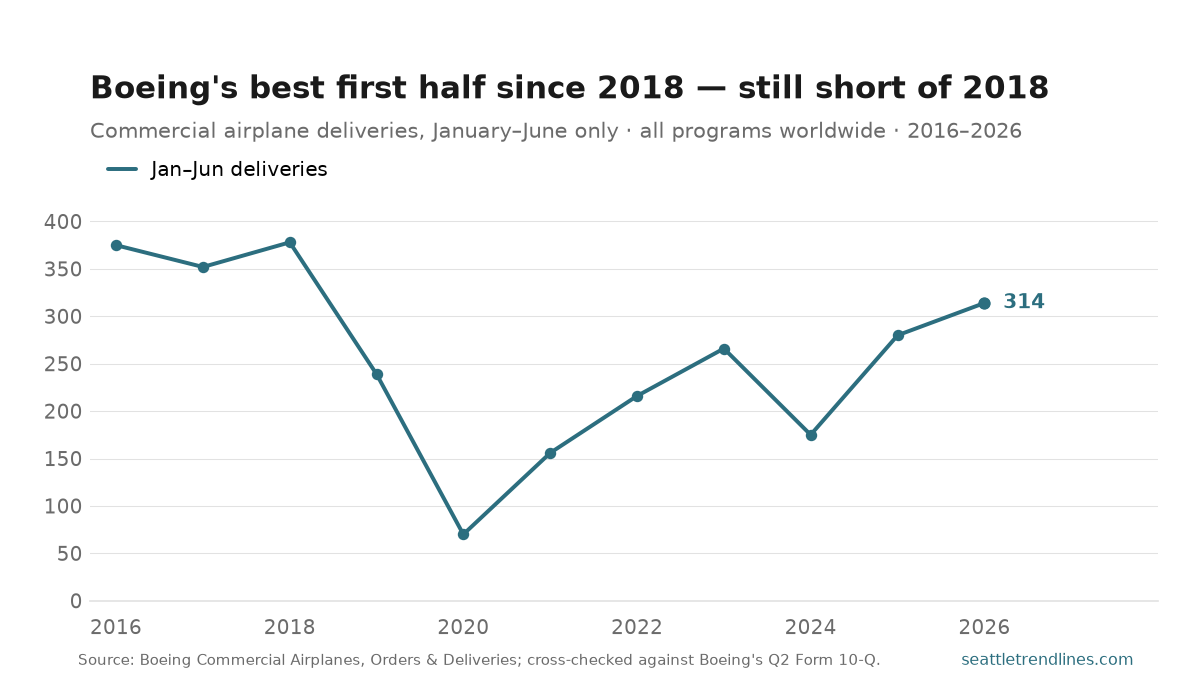
June brought Boeing’s second-quarter total to 171 jets and its first-half total to 314 — up 12% from the first half of 2025 and the company’s best first half since 2018, as 737 MAX output keeps climbing back from the strike- and quality-related slowdowns of 2024. The order book stayed deep: 121 gross orders in June, 445 gross (386 net) for the half, and a backlog of 6,202 aircraft at month-end — years of work for the region’s aerospace payrolls.
The chart is why “best first half since 2018” is both true and a smaller claim than it sounds. Boeing’s January–June count collapsed twice inside six years: to 239 in 2019, when the 737 MAX was grounded that March, and to 70 in the first half of 2020, when the airlines stopped taking airplanes at all. The climb back has been anything but a straight line — 156, then 216, then 266 in 2023, then a slide to 175 in the first half of 2024 after the January door-plug blowout put a regulator’s cap on MAX output. Two strong halves have followed. But the pre-grounding plateau was 375, 352 and 378 in 2016, 2017 and 2018. At 314, Boeing is still running about 17% below its 2018 pace. This is a recovery, not a return.
One caveat on reading the chart as a Puget Sound indicator: it counts every Boeing commercial delivery worldwide, the North Charleston 787s included, because that is the only basis on which the company reports the number consistently. The first-half 314 breaks down as 243 737s, 40 787s, 16 767s and 15 777s, so 274 of the 314 — 87% — were assembled in Washington, a slightly higher local share than June’s 54-of-64 (84%). The line’s shape — grounding, pandemic, door plug, recovery — is the Renton and Everett story. Its level runs about 15% above the region’s own count.
Source: Boeing Commercial, Orders & Deliveries (monthly, company IR). June 2026 program detail via Air Data News; first-half context via CNBC. Chart series: January–June deliveries by year, hand-pulled from Boeing’s monthly O&D summaries and cross-checked against the six-month delivery tables in Boeing’s Q2 Form 10-Q filings (data/boeing-h1-deliveries.csv carries the per-year citation). Final-assembly locations: 737 (Renton, WA), 767 and 777 (Everett, WA), 787 (North Charleston, SC). Boeing reports July deliveries in mid-August.