What it costs to keep Seattle comfortable, 2025
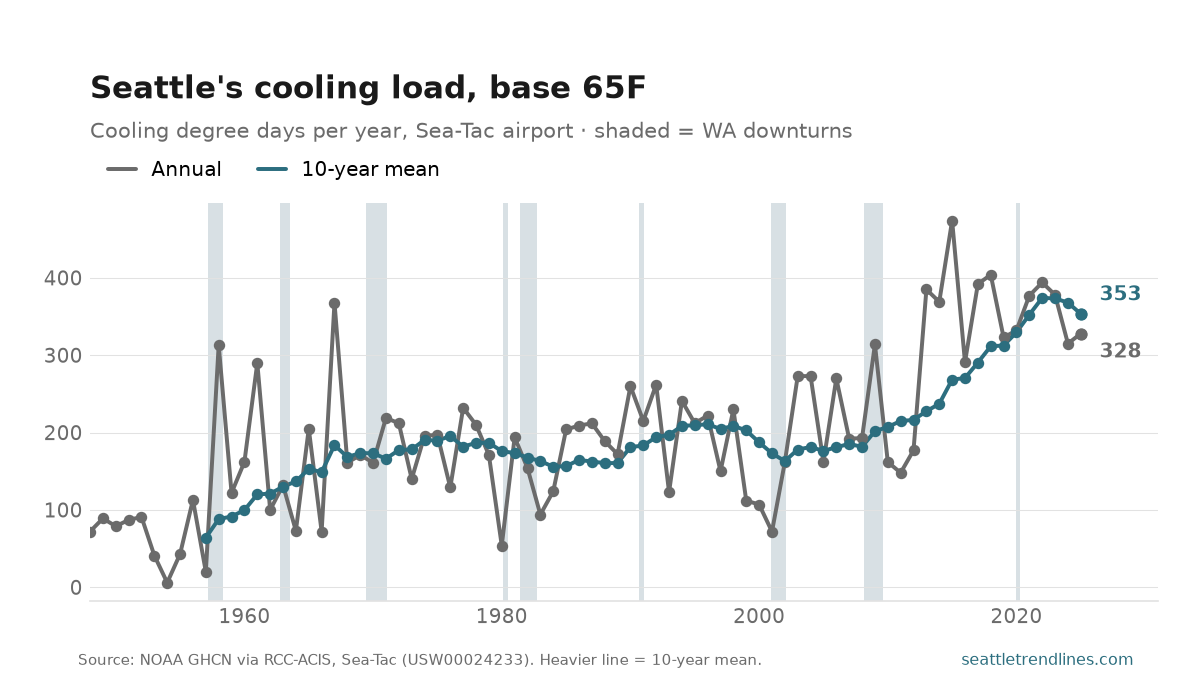
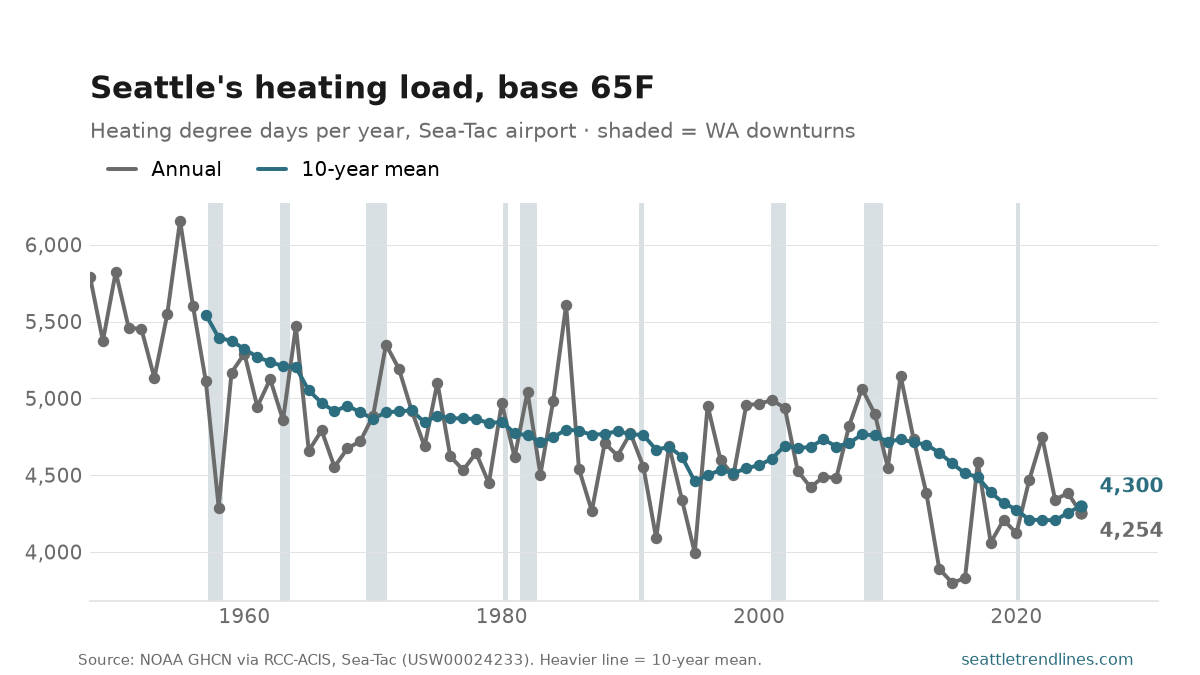
Sea-Tac ran up 328 cooling degree days in 2025 and 4,254 heating degree days. A degree day is one degree of gap between the day’s mean temperature and 65°F, summed over the year — a rough measure of how hard a building has to work, and the number utilities plan around.
The cooling side is the one that moved. Averaged over ten years to smooth the summers out, cooling degree days have gone from 64 in the decade ending 1957 to 353 in the decade ending 2025 — about 5.5 times what it was. That is the number behind every story about air conditioning arriving in a city that was built without it. The single worst year on record was 474 in 2015; the mildest was 6 in 1954.
And yet the building’s total work went down, not up. Heating degree days fell from 5,545 to 4,300 across the same span — a drop of 1,245 against a cooling rise of only 289. Seattle is a heating city with a warming climate, so the furnace saves far more than the air conditioner spends. That is a statement about degrees, not about energy: the two loads are not interchangeable — heat here is largely gas and electric resistance in winter, cooling is electricity on the summer afternoons when the grid is tightest. A smaller total load can still mean a higher peak.
The station is the caveat, and it is the same one the monthly Sea-Tac anomaly post carries. Sea-Tac is the only continuous daily record here back to 1948, and it is an airport with a great deal more tarmac around the thermometer than it had then. Some of the cooling-side climb is the airport growing rather than the region warming. Unlike the anomaly series, degree days have no fixed baseline to protect them from that — they are absolute counts — so read the direction rather than the decimal. Only complete calendar years are charted.
Source: NOAA Global Historical Climatology Network daily records for Seattle-Tacoma International Airport (USW00024233), retrieved through RCC-ACIS, degree days base 65°F summed over each complete calendar year. Bench post — generated from the latest observation in the site database.