King County has barely aged since 2009 — its suburbs are graying faster
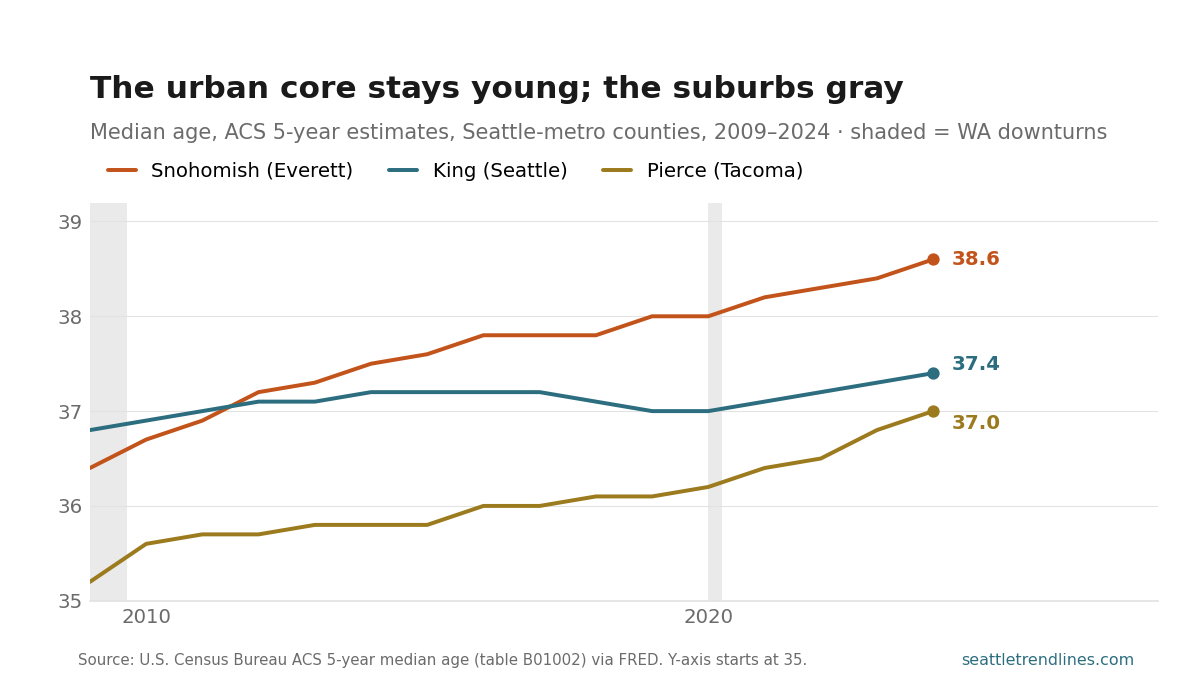
The U.S. median age rose about two years over this stretch. King County’s rose 0.6 — from 36.8 in the 2009 estimate to 37.4 in 2024 (up 0.1 on the year). The county that contains Seattle and Bellevue keeps replacing the people who age out with younger ones who move in, the same in-migration story behind its population growth.
The suburban ring is a different picture. Snohomish aged 2.2 years to 38.6, and Pierce 1.8 years to 37.0 — still the youngest of the three, but closing the gap fast. All three remain below the U.S. median of about 39.
Recessions leave no mark. Median age is a slow-moving stock, and the 5-year smoothing blunts it further; the shaded 2009 and 2020 downturns pass without a bend in any line.
This is the age side of a broader urban-versus-suburban split. The immigrant share of the population is pulling apart the same way — the county changing fast, the city holding flat.
Source: U.S. Census Bureau, American Community Survey 5-year estimates — median age, table B01002 (B01002_001E), retrieved via FRED’s County Median Age release (King, Pierce, Snohomish). 5-year period estimates dated to the end year; consecutive vintages overlap, so read the trend, not the year-to-year wiggle. State downturns: Philadelphia Fed Coincident Economic Activity Index for Washington. Annual; the 2020–2024 vintage was released 29 Jan 2026, so the next (2021–2025) is due around the end of 2026.